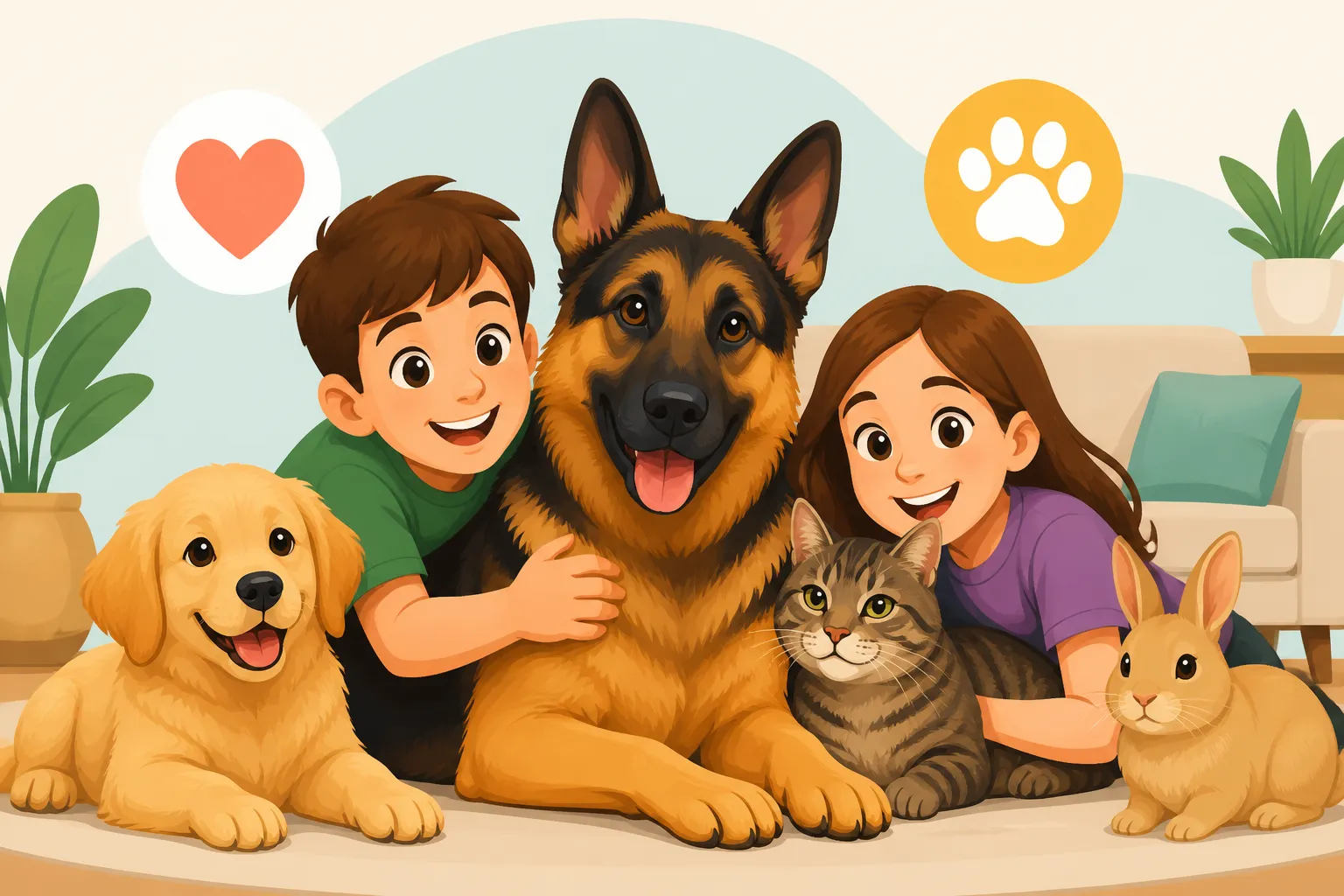
German Shepherds with Kids and Other Pets
Bringing a German Shepherd into a home already bustling with kids or other beloved pets can feel like a daunting task. You might be picturing endless chaos, chewed-up toys, or worse, conflict between your furry and human family members. This guide is here to walk you through the realities, address your worries, and provide practical strategies for successfully integrating your German Shepherd into a harmonious, multi-species household.
German Shepherds and Children: Building a Harmonious Household
Many families dream of a loyal German Shepherd as a protector and playmate for their children. It's a beautiful image, and often, it's a reality! However, it's also where many misunderstandings can arise. German Shepherds are incredibly intelligent and devoted, but they are also powerful dogs with strong instincts. Success hinges entirely on responsible ownership, consistent training, and understanding both your dog's nature and your children's developmental stages. Rushing this process or assuming they'll "just get along" is where trouble often starts.
Understanding the Protective Instinct
German Shepherds have a natural protective instinct that is deeply ingrained in their breed history. They were bred to herd and guard, and this translates into a strong desire to watch over their family, including the smallest members. While this is often seen as a positive trait, it's crucial to understand how it can manifest around children. A GSD might perceive rough-housing between siblings as a threat, or they might become overly possessive of a child, seeing them as "theirs" to guard, which can lead to reactivity towards strangers or other animals approaching the child. This isn't aggression for aggression's sake; it's often a misinterpretation of their role.
It's your job as the owner to guide this instinct, teaching your German Shepherd what is and isn't a genuine threat. This means exposing them to a variety of situations and people under controlled circumstances, rewarding calm behavior, and consistently reinforcing that you are the leader in all situations, including when children are involved. This careful balance prevents the protective instinct from becoming overprotective or possessive, which can lead to unintended consequences down the line.
Safe Introductions and Supervision Techniques
Whether you're bringing a German Shepherd puppy into a home with existing children, or introducing a new baby to an adult GSD, safe, controlled introductions are paramount. Never, ever just throw them together and hope for the best. For puppies, early, positive exposure to children (always supervised!) is essential for proper socialization. For existing adult GSDs, a new child needs to be introduced slowly, allowing the dog to associate positive experiences with the new arrival, rather than feeling replaced or stressed.
When introducing, always keep the dog on a leash, even if you trust them implicitly. Allow them to investigate the new smells and sounds from a safe distance. Reward calm curiosity. For very young children, teach them from the start that the dog is not a toy. No pulling tails, ears, or riding the dog. Designate "safe zones" for your German Shepherd where they can retreat from the children, such as a crate or a separate room. This gives them a vital break and prevents frustration from building up. Supervision isn't just watching; it's active intervention to guide interactions, prevent mishaps, and ensure both child and dog feel secure. For more detailed guidance on bringing a new puppy home, you might find our article on German Shepherd Puppy Training Guide helpful.
Teaching Children How to Interact
It's not just about training the dog; it's equally about educating the children. Kids need to learn how to respect a dog's space, recognize warning signs (like a dog turning its head away, yawning, or lip-licking), and understand appropriate ways to interact. Teach them the "petting rule": always pet gently, no poking, no pulling, and only when the dog approaches them willingly. If the dog walks away, it means they want space.
Role-playing these scenarios can be incredibly effective. Practice gentle petting, how to stand calmly when a dog approaches, and how to "be a tree" (stand still and quiet) if a dog jumps. Emphasize that dogs have feelings and need quiet time, just like people. Consistency from all adults in the household is key to ensuring these rules are followed, creating a predictable and safe environment for everyone. Investing in educational books or videos for children about dog safety can reinforce these lessons.
Navigating Multi-Dog Households with a German Shepherd
Bringing a German Shepherd into a home that already has other dogs, or adding another dog to a GSD's existing territory, requires careful planning and a deep understanding of canine social dynamics. German Shepherds, particularly intact males, can sometimes be prone to same-sex dog aggression, or they may try to assert dominance if not properly managed. This isn't a given for every GSD, but it's a factor you absolutely need to be aware of and proactively manage.
Early Socialization and Temperament Matching
The foundation for a harmonious multi-dog home starts with early and ongoing socialization for your German Shepherd. From puppyhood, expose them to a wide variety of friendly, vaccinated dogs in different settings – puppy classes, dog parks (once fully vaccinated and appropriate), supervised playdates. This helps them learn appropriate canine social cues and manners. However, "socialization" doesn't mean letting your GSD run wild with every dog they see. It means controlled, positive experiences that build confidence and good behavior. For an existing adult GSD, even if they were well-socialized as a puppy, continued exposure to other dogs is important to maintain those skills.
When considering adding another dog, temperament matching is crucial. A very dominant German Shepherd might not do well with another strong-willed breed. Conversely, a shy GSD might be overwhelmed by an overly boisterous new playmate. Look for a dog with a complementary personality – often, a dog of the opposite sex or a more submissive, calmer demeanor can be a good fit. Avoid bringing in another dog of a similar age and sex to an existing German Shepherd, especially if your GSD has a history of dog-dog reactivity.
Managing Resources and Preventing Conflicts
One of the biggest triggers for conflict in multi-dog households is resource guarding. This can involve food, toys, beds, even human attention. German Shepherds, with their strong guarding instincts, can be particularly prone to this. To prevent issues, always feed dogs separately, in different rooms or crates, especially if one dog eats faster than the other. Pick up all toys and chews when not actively supervised. Provide plenty of high-value, distinct beds or resting spots so each dog has their own sanctuary.
Attention from humans is also a resource. Ensure you're giving equal attention and affection to all dogs. Avoid favoring one over the other, as this can breed resentment or competition. Practice training exercises with each dog individually and together, always rewarding calm coexistence. Establishing clear boundaries around resources and human interaction from day one can significantly reduce the potential for squabbles. If you're seeing signs of resource guarding, it’s a behavior issue that needs immediate attention; our guide on German Shepherd Behavior Problems and Solutions offers more insights.
Introducing an Adult GSD to Another Dog
Introducing an adult German Shepherd to a new canine family member requires a strategic, slow approach. The initial meeting should always happen on neutral territory – a local park or a friend's yard, not your home. Both dogs should be on leashes, handled by separate people. Start with parallel walks, allowing them to be in each other's presence without direct interaction. Keep the leashes loose; tension on the leash can transfer to the dog.
If they show calm, positive body language, allow brief, supervised nose-to-tail greetings, always ready to intervene if tension rises. Avoid face-to-face greetings initially, as these can be confrontational. Once they're comfortable on neutral ground, bring them into your home, still on leashes, and continue to supervise all interactions closely. Never leave them unsupervised until you are absolutely certain they are comfortable and safe together, which can take days, weeks, or even months. Consistency, patience, and a keen eye for canine body language are your best tools during this critical phase.
German Shepherds and Feline Friends: Bridging the Species Gap
The idea of a German Shepherd and a cat living peacefully together might seem like something out of a Disney movie, especially given the GSD's strong prey drive. While it certainly presents a unique set of challenges, it's absolutely achievable for many households with the right approach and a good understanding of both species' needs and behaviors.
Understanding the Prey Drive Challenge
German Shepherds were bred for herding and protection, which means they possess a natural instinct to chase and capture smaller, faster-moving animals. This prey drive is a strong, innate behavior, and for many GSDs, a darting cat can trigger it instantly. It's not about malice; it's simply instinct. For some German Shepherds, this drive will be minimal and easy to redirect; for others, it will be incredibly strong and require constant management. It's vital to assess your individual dog's prey drive before even attempting an introduction.
If your German Shepherd regularly chases squirrels, rabbits, or even shadows with intense focus, their prey drive is likely high. While training can manage this to a degree, it's a fundamental instinct that you can't erase. The goal is to teach your GSD to associate the cat with positive experiences and to redirect their predatory urges onto appropriate outlets, like toys or specific games. Ignoring a high prey drive or hoping it will disappear is irresponsible and can lead to dangerous situations for your feline companion. Our article, German Shepherd Prey Drive Explained, delves deeper into this topic.
Step-by-Step Introduction Protocols
Introducing a German Shepherd to a cat needs to be a very slow, controlled, and scent-focused process. Start by keeping them completely separate, allowing them to get used to each other's scent. Swap blankets or toys between their areas. This helps them normalize the other's presence without direct interaction. Once they are calm around the other's scent, move to visual introductions. Keep your GSD on a leash, and the cat in a carrier or behind a baby gate, allowing them to see each other from a distance. Reward calm behavior from both.
Gradually increase the proximity and duration of these supervised sessions. Always ensure the cat has an escape route or high perches it can easily reach. Never force interactions. If the GSD is too focused on the cat, immediately redirect their attention with a treat or a toy. Over time, with consistent positive reinforcement and calm supervision, many German Shepherds can learn to tolerate, and even bond with, their feline housemates. This process can take weeks or even months, so patience is absolutely key. For more in-depth steps, refer to How to Introduce a German Shepherd to a Cat.
Creating Safe Zones for Cats
Regardless of how well your German Shepherd and cat get along, it is crucial that your cat always has safe zones where the dog cannot reach them. This is not just for initial introductions, but for their entire co-existence. These safe zones provide the cat with a sense of security and allow them to escape if they ever feel overwhelmed or threatened by the dog, even inadvertently. High shelves, cat trees, or rooms with baby gates that the cat can easily jump over but the dog cannot are excellent options.
Ensuring the cat's food, water, and litter box are in these dog-free zones also prevents resource guarding issues from the German Shepherd and provides the cat with undisturbed access to their necessities. Many cat owners find specialized cat furniture or even cleverly placed furniture from online retailers like Chewy invaluable for creating these vertical escapes. A peaceful cohabitation is less about turning your GSD into a cat-lover overnight and more about intelligent management and respecting the needs of both animals.
German Shepherds with Smaller or Exotic Pets: A Higher Hurdle
When it comes to German Shepherds and very small or exotic pets like hamsters, guinea pigs, rabbits, birds, or reptiles, the challenge escalates significantly due to the strong prey drive inherent in many GSDs. While it's not impossible to have both, it requires an extremely high level of vigilance, strict management, and often, complete separation.
Assessing the Risks and Natural Instincts
The fundamental issue here is the size disparity and the German Shepherd's natural hunting and chasing instincts. To a GSD, a tiny, scurrying rodent or a flapping bird can look and move exactly like prey. This isn't a behavior problem as much as it is a natural, hardwired instinct. No amount of training will completely remove a German Shepherd's prey drive for these types of animals, and it would be unfair and dangerous to expect it to. The risk of accidental injury or fatality to the smaller pet is simply too high for many German Shepherds.
Before considering such a household, you must be brutally honest about your GSD's prey drive. Has your German Shepherd ever caught a bird or a squirrel outside? Do they obsessively watch small animals? If the answer is yes, then attempting to integrate them with smaller pets under the same roof will require an almost militaristic approach to management. The emotional toll of an accident would be devastating, so prevention must be the absolute priority.
Strict Management and Separation Strategies
For households with German Shepherds and small or exotic pets, the golden rule is often complete and permanent separation. This means:
- Dedicated Rooms: Small pets should live in secure rooms that the German Shepherd can never access. Doors must be kept closed and secure at all times.
- Secure Enclosures: The smaller pet's enclosure (cage, tank, aviary) must be absolutely dog-proof. It should be strong, have secure locks, and ideally be placed out of direct reach of the GSD, even if they were to get into the room.
- Supervision is 24/7: Even with dedicated rooms, there should be no opportunity for unsupervised interaction. If the small pet is out of its cage, the German Shepherd must be secured in a separate area or on a leash with active, direct supervision.
- Scent Management: Even scent can trigger a GSD's prey drive. Consider air purifiers or ensure rooms are well-ventilated to minimize the transfer of animal scents.
While some GSDs might be trained to ignore these smaller creatures, the risk is almost always present. It places an immense burden on the owner to be constantly vigilant. For the safety and well-being of the smaller pet, and to prevent undue stress on your German Shepherd, strict, uncompromising separation is typically the safest and most responsible strategy.
Training, Boundaries, and Ongoing Management for a Peaceful Home
No matter the combination of kids and pets in your household, achieving harmony with a German Shepherd at the helm is an ongoing project, not a one-time fix. It demands a significant commitment to training, establishing clear boundaries, and consistent management from every member of the family. This is where the true effort lies, but the rewards of a well-adjusted, integrated GSD are immeasurable.
Consistent Training is Non-Negotiable
A well-trained German Shepherd is a safer, happier, and more manageable dog, especially in a busy family environment. Basic obedience commands like "sit," "stay," "come," "leave it," and a solid "down" are not just party tricks; they are essential safety commands that can prevent a multitude of problems. For example, a reliable "leave it" command can stop your GSD from bothering a child or chasing a cat. A strong "come" can recall them from a potentially risky situation. Consistency is paramount: everyone in the household should use the same commands and expectations.
Beyond basic obedience, focus on impulse control exercises. Teaching your GSD to wait patiently for food, to not rush through doors, or to calmly sit when guests arrive helps them learn to control their instincts in stimulating situations. Enroll in obedience classes, watch reputable online tutorials, or consult with a professional trainer. Remember, training is an ongoing process throughout your German Shepherd's life, not just during puppyhood. Our guide on German Shepherd Obedience Training Basics can provide a great starting point.
The Role of Exercise and Mental Stimulation
A bored or under-exercised German Shepherd is a recipe for disaster in any home, but especially one with kids and other pets. These dogs are highly intelligent and possess a significant amount of energy. If that energy isn't channeled constructively, it will find its own outlets, often in destructive or problematic behaviors like excessive barking, chewing, or chasing. This can create undue stress for children and other pets.
Daily exercise, both physical and mental, is absolutely critical. This doesn't just mean a quick walk around the block; it means vigorous activity like long hikes, running, fetching, or structured play sessions. Mental stimulation is equally important. Puzzle toys, scent work, advanced obedience training, or learning new tricks can tire out a German Shepherd's mind just as effectively as physical exercise. Consider durable, engaging toys, perhaps from a selection found on sites like Chewy, to keep their minds engaged. A tired German Shepherd is a calm German Shepherd, which significantly contributes to a peaceful multi-species household. You can find more ideas in German Shepherd Exercise Requirements.
When to Seek Professional Guidance
Sometimes, despite your best efforts, you might encounter challenges that feel beyond your capabilities. This is absolutely normal and nothing to be ashamed of. German Shepherds are complex, powerful dogs, and their behaviors can sometimes require expert intervention. If you're struggling with aggression towards children or other pets, severe resource guarding, uncontrollable prey drive, or any behavior that compromises safety or quality of life, it's time to call in a professional.
Look for certified professional dog trainers or veterinary behaviorists who have experience with German Shepherds and multi-pet households. They can assess your specific situation, identify underlying causes for behavior, and develop a tailored training plan. Don't wait until a small problem becomes a major crisis. Early intervention is always more effective and can prevent more serious issues down the road, ensuring everyone, two-legged and four-legged alike, can live together happily and safely.
| Introduction Scenario | Key Considerations | Essential Steps | What to Watch For |
|---|---|---|---|
| GSD & Children | GSD's protective instinct, child's understanding | Supervised, positive introductions; teach kids dog safety; establish dog's safe space | Over-guarding, fear, child teasing, dog becoming a "toy" |
| GSD & Other Dogs | GSD's potential for same-sex aggression, prey drive | Neutral territory intro; separate feeding; manage resources; ample separate attention | Resource guarding, stiff body language, growling, lunging, ignoring commands |
| GSD & Cats | GSD's prey drive, cat's escape needs | Scent swapping; visual separation (gates); cat-only high perches; reward calm behavior | Intense staring, stalking, chasing, cat showing fear or aggression |
| GSD & Small/Exotic Pets | High prey drive, size difference | Strict, permanent physical separation; secure enclosures; no unsupervised contact | GSD obsession with cage, pawing at enclosure, signs of stress in small pet |
Disclaimer
This article is for general informational purposes only and does not constitute professional advice. Laws, prices and regulations vary by location and change over time. Consult a qualified professional for guidance on your specific situation.