How to Train a German Shepherd to Stop Pulling
One of the most common frustrations German Shepherd owners face is the relentless pulling on the leash. It’s not just annoying; a powerful dog like a GSD dragging you down the street can be downright dangerous, leading to falls or even injuries. This guide will walk you through practical, empathetic strategies to teach your strong, intelligent German Shepherd to walk politely on a leash, making walks enjoyable for both of you.
Understanding Why Your German Shepherd Pulls
Let's be real, a German Shepherd's natural instinct isn't to walk politely by your side. They are bred for work, intelligence, and often have a strong prey drive and boundless energy. When they pull, they're not trying to be defiant; they're simply acting on instinct and learned behavior. Understanding the root causes is the first step toward effective training.
High Energy and Excitement
German Shepherds are high-energy dogs. A walk, especially after being cooped up, is an explosion of sensory information and excitement. Their natural exuberance often translates into wanting to get to the next exciting smell, person, or squirrel right now. For many GSDs, the world is a thrilling place, and they want to explore it at their own pace, which is usually much faster than ours. If they haven't learned otherwise, they'll simply lean into the leash and go. This is especially true for younger dogs or those who haven't had adequate exercise before a walk.
It's easy to forget that what's a routine stroll for us is an adventure for them. Think about a young child on a playground – they're not trying to be disobedient by running ahead; they're just thrilled and want to experience everything! Your German Shepherd often feels the same way. Their sheer physical strength combined with this excitement can make pulling feel almost effortless to them, reinforcing the behavior with every step they get to take while pulling.
Lack of Early Leash Training and Socialization
Many puppies don't receive proper leash training from day one. Owners often inadvertently teach their German Shepherd that pulling gets them where they want to go. Every time your dog pulls and you continue walking, even if it's just a few steps, you've rewarded the pulling. It’s a classic case of positive reinforcement for undesirable behavior. Over time, this becomes deeply ingrained.
Furthermore, insufficient German Shepherd socialization: step-by-step can contribute to pulling. A dog that is overwhelmed or overly excited by new sights, sounds, and smells on a walk might pull simply out of anxiety, fear, or over-arousal. If they weren't exposed to various environments and stimuli in a positive way during their critical developmental periods, the world can seem like a chaotic place, and pulling might be their way of trying to escape or get closer to something intriguing. This is why consistent, positive exposure to different environments is crucial, not just for good manners but for their overall well-being.
Instincts and Pack Dynamics
German Shepherds have a strong desire to patrol, protect, and explore. In their minds, they might see themselves as leading the "pack" on a walk. If you're not clearly communicating that you're in charge of the direction and pace, they will naturally step into that role. This isn't dominance in a confrontational sense, but rather a perceived vacuum in leadership that they're happy to fill. Their incredible noses also mean they're constantly on scent trails, pulling to investigate every intriguing smell. These innate drives, combined with their physical power, make teaching a loose leash walk a significant training endeavor.
They are also territorial and watchful by nature. This means they might pull harder to get to the edge of what they perceive as their territory to investigate a new person or dog, or to bark and send a message. Understanding this aspect of their German Shepherd temperament and personality helps us approach training not as a battle of wills, but as guiding their natural instincts into acceptable behaviors.
Essential Tools for Leash Training Success
Choosing the right equipment isn't just about comfort; it's about safety and effectiveness. The wrong tools can exacerbate pulling, while the right ones can make a world of difference in your training journey.
No-Pull Harnesses
When you’re dealing with a strong German Shepherd, a no-pull harness can be a game-changer. These harnesses are designed to redirect your dog's forward momentum without causing discomfort or harm.
- Front-Clip Harnesses: These harnesses have a leash attachment point on the dog's chest. When your German Shepherd pulls, the leash pulls them gently to the side, turning them away from their forward path. This makes it difficult for them to continue pulling effectively. Many owners find these highly effective for immediate relief from pulling. Brands like the Easy Walk Harness or the Freedom No-Pull Harness, often found on Amazon, are popular choices.
- Head Halters (Halti, Gentle Leader): These resemble muzzles but are purely for control, not restraint. They loop over your dog’s nose and around their neck. The leash attaches under the chin. When your dog pulls, the halter gently guides their head, and where the head goes, the body follows. They offer excellent control but require a positive introduction to ensure your dog accepts wearing it comfortably. Start with very short periods, rewarding heavily with treats.
Here's a quick comparison of popular no-pull devices:
| Device Type | Attachment Point | Mechanism for Control | Pros | Cons |
|---|---|---|---|---|
| Flat Collar | Back (neck) | Direct pressure on neck when pulled | Simple, inexpensive, common | Can cause tracheal damage; no pulling deterrent; less control |
| Martingale Collar | Back (neck) | Tightens slightly when pulled, prevents slipping | Good for escape artists, gentle tightening | Still allows pulling; not a true "no-pull" device |
| Back-Clip Harness | Back (shoulders) | Distributes pressure evenly across chest and back | Comfortable, prevents neck injury | Offers no leverage against pulling; can encourage pulling |
| Front-Clip Harness | Front (chest) | Redirects dog sideways when they pull | Effective no-pull, gentle, easy to use | Can sometimes tangle legs; requires proper fit |
| Head Halter | Under chin (over muzzle) | Guides dog's head, body follows | Excellent control, gentle redirect | Can be difficult for dogs to accept initially; requires training |
Appropriate Leash and Collar
While no-pull harnesses are great, a standard 6-foot leash is also essential. Look for durable materials like nylon or leather. Avoid retractable leashes, as they teach your dog that pulling extends their roaming distance, which is the opposite of what we want. They also offer less control and can be dangerous.
For a collar, a flat buckle collar or a martingale collar (especially if your GSD has a smaller head or can slip out of a regular collar) is suitable for holding ID tags and general use, but they shouldn't be the primary tool for a dog that pulls significantly during training sessions. A proper fit is crucial for any collar – you should be able to fit two fingers comfortably between the collar and your dog's neck.
Step-by-Step Guide to Training Loose Leash Walking
Consistency and patience are key when teaching your German Shepherd to stop pulling. This isn't a quick fix; it's a process of clear communication and positive reinforcement.
Start in a Low-Distraction Environment
Begin your training indoors or in a very quiet backyard. The goal is to set your German Shepherd up for success, and a busy park is not the place to start when they're still learning. Get a handful of high-value treats – small, soft, and irresistible to your dog.
- Introduce the Equipment: Let your dog wear their no-pull harness or head halter for short periods, associating it with positive experiences like treats and praise. Don't go straight to a walk.
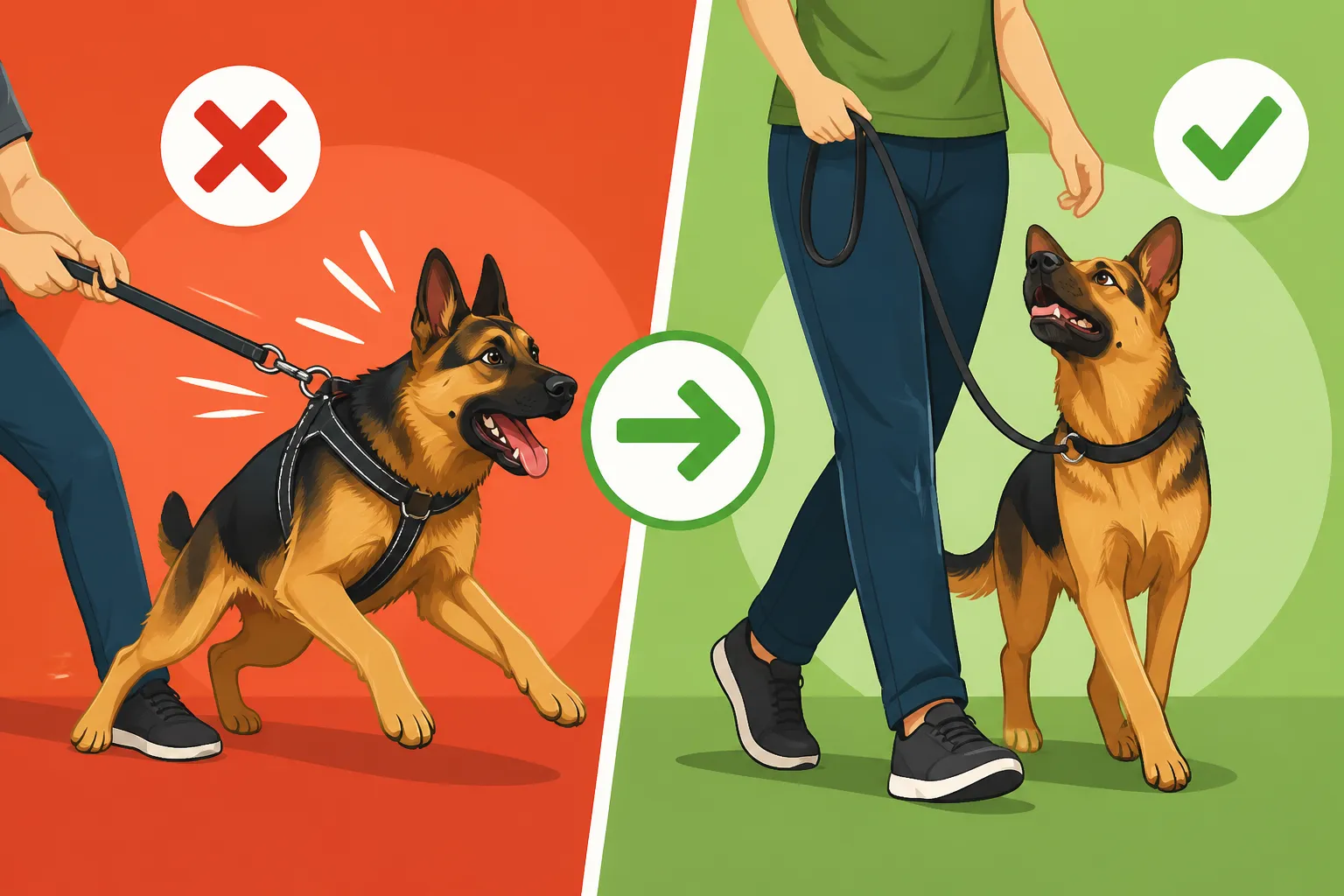
- Basic "Let's Go" or "Heel" Command: With your dog on the leash, stand still. As soon as there's slack in the leash (even a tiny bit), say "Yes!" or "Good!" and give a treat at your side. Take one step forward. If the leash remains loose, reward again. If it tightens, immediately stop moving. Stand still, wait for the leash to slacken (this might involve your dog looking back at you, or bumping into the end of the leash and realizing you've stopped), and then reward and resume walking. The moment they relieve tension, that's your cue to mark and reward. This is a core principle of German Shepherd leash training: step-by-step.
- Practice Changing Directions: After a few steps of loose leash walking, abruptly change direction. This teaches your dog to pay attention to you rather than forging ahead. If they pull, change direction. If they stay with you, reward heavily. This keeps them guessing and focused on your movements.
Gradually Increase Distractions
Once your German Shepherd consistently walks nicely in a quiet environment, it's time to slowly introduce more distractions.
- Controlled Outdoor Spaces: Move to a quiet street or a park during off-peak hours. The principles remain the same: walk forward, reward loose leash, stop if they pull. The key is to make it boring to pull and rewarding to stay close.
- Work Around Mild Distractions: Practice near parked cars, quiet houses, or other people at a distance. If your German Shepherd gets overly excited or pulls towards a distraction, gently steer them away with your no-pull harness or head halter, or simply stop until they calm down and the leash slackens. You can also use commands like "Look at me!" to re-engage their focus, rewarding them for choosing to look at you over the distraction. Many people find structured online training courses, like those offered by BAXTER & Bella, excellent for guiding through this progression with expert advice.
- Encountering Other Dogs or People: This is often the biggest challenge. Start by practicing at a distance where your GSD can see the distraction but isn't reacting strongly. Reward calm behavior. As they improve, gradually decrease the distance. If your German Shepherd reacts by pulling or barking, increase the distance again. Remember, the goal is always to keep them under their threshold of reactivity. For a deeper dive into dealing with reactivity, you might find information on German Shepherd reactivity on walks helpful.
Reinforcement and Consistency
Loose leash walking isn't a "one and done" training session. It requires ongoing reinforcement.
- Always Reward Loose Leash: Every single walk, carry treats. Reward frequently when your German Shepherd is walking nicely by your side, even if it's just for a few seconds. The more you reward the desired behavior, the more it will stick.
- Be a "Tree": This is a golden rule. The moment your German Shepherd pulls, you become a "tree." Stop dead in your tracks. Do not move forward until the leash is loose. This teaches them that pulling literally gets them nowhere. It can feel tedious at first, but it's incredibly effective.
- Vary Your Pace and Direction: Keep your dog engaged by periodically speeding up, slowing down, or making unexpected turns. This forces them to pay attention to you, rather than just pulling linearly. This helps build a strong foundation for advanced obedience, like the "heel" command, which is a key part of German Shepherd obedience training basics.
- Practice Short, Frequent Sessions: Instead of one long, frustrating walk, do several short training sessions throughout the day. This keeps your dog engaged and prevents them from getting overtired or frustrated. Even 5-10 minute sessions can build excellent habits over time. Remember, consistency is king when you're trying to train a German Shepherd.
Common Challenges and Troubleshooting
Even with the best intentions and tools, you’re bound to hit some bumps in the road. German Shepherds are smart, but they can also be stubborn or revert to old habits, especially when faced with irresistible temptations.
Dealing with Stubbornness or Regression
There will be days when your German Shepherd seems to forget everything you’ve taught them. They might pull like a freight train, especially if they catch a particularly interesting scent or spot a squirrel. Don't get discouraged! This is completely normal.
- Revisit Basics: If your dog regresses, simply go back to a less distracting environment. Practice the "be a tree" method rigorously. Sometimes, they just need a refresher course. Remember to use those high-value treats to make it extra rewarding to comply.
- Shorten Training Sessions: If they're struggling, cut walks or training sessions short before they get overwhelmed or frustrated. End on a positive note, even if it’s just a few seconds of loose leash walking.
- Check Equipment: Ensure your no-pull harness or head halter is still fitting correctly. As dogs grow or if they’ve lost/gained weight, equipment can become uncomfortable or less effective. You can always find a wide variety of sizes and styles of training gear on Amazon to ensure a perfect fit.
High Prey Drive and Reactivity on Leash
German Shepherds often have a strong prey drive, making squirrels, rabbits, or even blowing leaves irresistible. This can lead to explosive pulling or lunging.
- Management is Key: Until your training is solid, manage their environment. Avoid areas with known triggers if you can. If you see a trigger approaching, get your dog's attention with a treat before they notice it.
- "Watch Me" or "Look" Command: Teach your German Shepherd to make eye contact with you on command. Practice this in various environments. When you see a distraction, ask for "Watch Me," reward, and then calmly walk past the distraction. This teaches them to check in with you rather than fixating. This command is an excellent addition to your list of German Shepherd basic commands every owner should teach.
- Counter-Conditioning and Desensitization: If your dog reacts aggressively or excessively to specific triggers (like other dogs), you'll need to work on changing their emotional response. This involves pairing the trigger (at a distance where your dog is not reacting) with something positive, like high-value treats. The goal is for them to eventually associate the trigger with good things happening. This is a more advanced training technique and might benefit from the guidance of a professional trainer or resources like the BAXTER & Bella online puppy school which often covers such topics in detail.
Distractions on Walks
The world is full of amazing smells, sounds, and sights for your German Shepherd. Overcoming these distractions requires patience and consistency.
- Keep Walks Interesting: While we want them focused on us, don't make walks solely about strict obedience. Allow them sniffing time in appropriate areas. A balance keeps them engaged and less likely to feel frustrated. You can even incorporate some mental games during walks to keep their minds active. For more ideas, check out best mental stimulation for German Shepherds.
- Practice in Bursts: When you encounter a distracting area (like a busy street or a dog park perimeter), increase your rate of rewards. Treat every two or three steps that they walk nicely. Once you're past the high-distraction zone, you can ease up a bit.
- Long Line Practice: In a safe, enclosed area, you can practice loose leash walking with a longer line (15-30 feet). This gives them a bit more freedom to explore but still teaches them the concept of not pulling, as you can still "be a tree" if they hit the end of the line. Just be sure to use a harness, not a collar, with a long line to avoid neck injuries. This also gives them more room to explore and burn some of that significant German Shepherd exercise requirements energy.
Training a German Shepherd to stop pulling on the leash can be a significant undertaking, but it's incredibly rewarding. With the right tools, a consistent approach, and a lot of patience, you'll soon be enjoying those peaceful, pleasant walks you've always dreamed of.
Disclaimer
The information provided in this guide is for general educational purposes only and should not be considered a substitute for professional veterinary advice or professional dog training consultation. Every dog is an individual, and results may vary. Always consult with a qualified veterinarian or certified professional dog trainer before implementing any new training techniques, especially if your German Shepherd exhibits aggression or other serious behavioral issues.